Anlage 9 - Verwendungsbereich
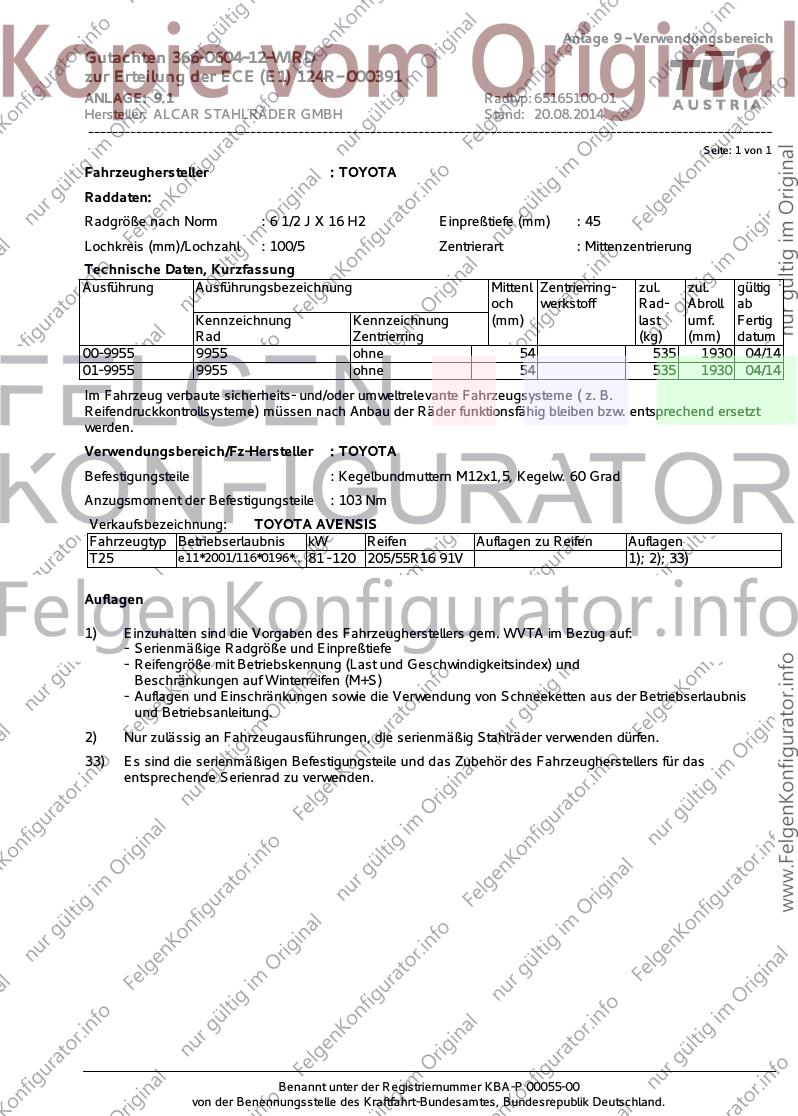
Gutachten 366-0604-12-WIRD
zur Erteilung der ECE (E1) 124R- 000391
ANLAGE: 9.1 Radtyp: 65165100-01
Hersteller: ALCAR STAHLRÄDER GMBH Stand: 20.08.2014
__________________________________________________________________________________________________________________
Seite: 1 von 1
Fahrzeughersteller : TOYOTA
Raddaten:
Radgröße nach Norm : 6 1/2 J X 16 H2 Einpreßtiefe (mm) : 45
Lochkreis (mm)/Lochzahl : 100/5 Zentrierart : Mittenzentrierung
Technische Daten, Kurzfassung
Ausführung Ausführungsbezeichnung Mittenl Zentrierring- zul. zul. gültig
och werkstoff Rad- Abroll ab
Kennzeichnung Kennzeichnung (mm) last umf. Fertig
Rad Zentrierring (kg) (mm) datum
00-9955 9955 ohne 54 535 1930 04/14
01-9955 9955 ohne 54 535 1930 04/14
Im Fahrzeug verbaute sicherheits- und/oder umweltrelevante Fahrzeugsysteme ( z. B.
Reifendruckkontrollsysteme) müssen nach Anbau der Räder funktionsfähig bleiben bzw. entsprechend ersetzt
werden.
Verwendungsbereich/Fz-Hersteller : TOYOTA
Befestigungsteile : Kegelbundmuttern M12x1,5, Kegelw. 60 Grad
Anzugsmoment der Befestigungsteile : 103 Nm
Verkaufsbezeichnung: TOYOTA AVENSIS
Fahrzeugtyp Betriebserlaubnis kW Reifen Auflagen zu Reifen Auflagen
T25 e11*2001/116*0196*.. 81 - 120 205/55R16 91V 1); 2); 33)
Auflagen
1) Einzuhalten sind die Vorgaben des Fahrzeugherstellers gem. WVTA im Bezug auf:
- Serienmäßige Radgröße und Einpreßtiefe
- Reifengröße mit Betriebskennung (Last und Geschwindigkeitsindex) und
Beschränkungen auf Winterreifen (M+S)
- Auflagen und Einschränkungen sowie die Verwendung von Schneeketten aus der Betriebserlaubnis
und Betriebsanleitung.
2) Nur zulässig an Fahrzeugausführungen, die serienmäßig Stahlräder verwenden dürfen.
33) Es sind die serienmäßigen Befestigungsteile und das Zubehör des Fahrzeugherstellers für das
entsprechende Serienrad zu verwenden.
Benannt unter der Registriernummer KBA-P 00055-00
von der Benennungsstelle des Kraftfahrt-Bundesamtes, Bundesrepublik Deutschland.
� (E1)-124 R - 000391
Size: 6.50x16
Type: 65165100-01
Date: 08.02.2021
per 366-0604-12-WIRD 1/2
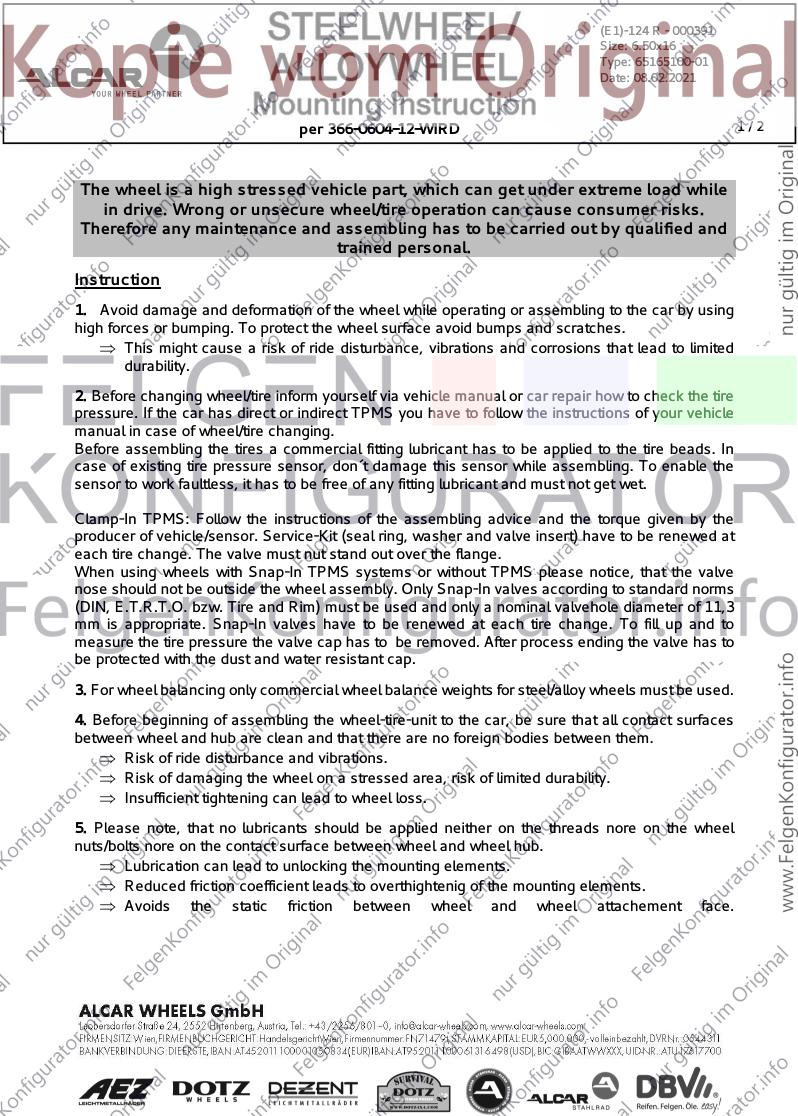
The wheel is a high stressed vehicle part, which can get under extreme load while
in drive. Wrong or unsecure wheel/tire operation can cause consumer risks.
Therefore any maintenance and assembling has to be carried out by qualified and
trained personal.
Instruction
1. Avoid damage and deformation of the wheel while operating or assembling to the car by using
high forces or bumping. To protect the wheel surface avoid bumps and scratches.
This might cause a risk of ride disturbance, vibrations and corrosions that lead to limited
durability.
2. Before changing wheel/tire inform yourself via vehicle manual or car repair how to check the tire
pressure. If the car has direct or indirect TPMS you have to follow the instructions of your vehicle
manual in case of wheel/tire changing.
Before assembling the tires a commercial fitting lubricant has to be applied to the tire beads. In
case of existing tire pressure sensor, don´t damage this sensor while assembling. To enable the
sensor to work faultless, it has to be free of any fitting lubricant and must not get wet.
Clamp-In TPMS: Follow the instructions of the assembling advice and the torque given by the
producer of vehicle/sensor. Service-Kit (seal ring, washer and valve insert) have to be renewed at
each tire change. The valve must nut stand out over the flange.
When using wheels with Snap-In TPMS systems or without TPMS please notice, that the valve
nose should not be outside the wheel assembly. Only Snap-In valves according to standard norms
(DIN, E.T.R.T.O. bzw. Tire and Rim) must be used and only a nominal valvehole diameter of 11,3
mm is appropriate. Snap-In valves have to be renewed at each tire change. To fill up and to
measure the tire pressure the valve cap has to be removed. After process ending the valve has to
be protected with the dust and water resistant cap.
3. For wheel balancing only commercial wheel balance weights for steel/alloy wheels must be used.
4. Before beginning of assembling the wheel-tire-unit to the car, be sure that all contact surfaces
between wheel and hub are clean and that there are no foreign bodies between them.
Risk of ride disturbance and vibrations.
Risk of damaging the wheel on a stressed area, risk of limited durability.
Insufficient tightening can lead to wheel loss.
5. Please note, that no lubricants should be applied neither on the threads nore on the wheel
nuts/bolts nore on the contact surface between wheel and wheel hub.
Lubrication can lead to unlocking the mounting elements.
Reduced friction coefficient leads to overthightenig of the mounting elements.
Avoids the static friction between wheel and wheel attachement face.
� (E1)-124 R - 000391
Size: 6.50x16
Type: 65165100-01
Date: 08.02.2021
per 366-0604-12-WIRD 2/2
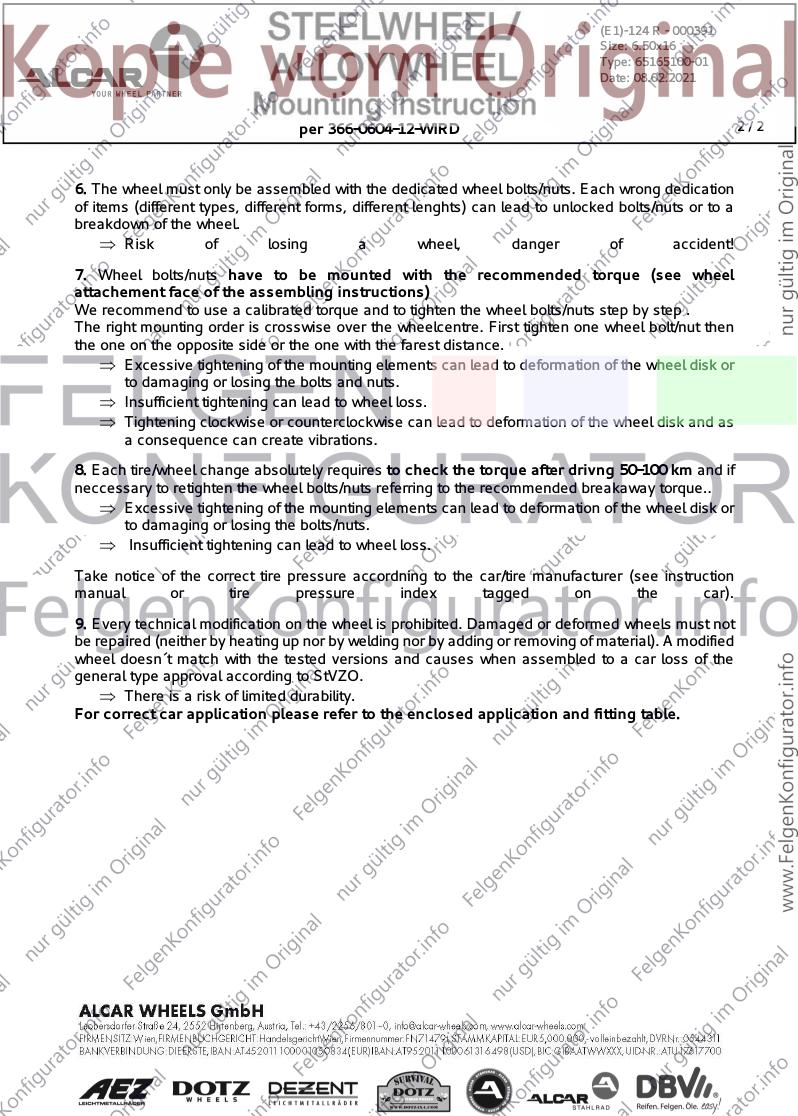
6. The wheel must only be assembled with the dedicated wheel bolts/nuts. Each wrong dedication
of items (different types, different forms, different lenghts) can lead to unlocked bolts/nuts or to a
breakdown of the wheel.
Risk of losing a wheel, danger of accident!
7. Wheel bolts/nuts have to be mounted with the recommended torque (see wheel
attachement face of the assembling instructions)
We recommend to use a calibrated torque and to tighten the wheel bolts/nuts step by step .
The right mounting order is crosswise over the wheelcentre. First tighten one wheel bolt/nut then
the one on the opposite side or the one with the farest distance.
Excessive tightening of the mounting elements can lead to deformation of the wheel disk or
to damaging or losing the bolts and nuts.
Insufficient tightening can lead to wheel loss.
Tightening clockwise or counterclockwise can lead to deformation of the wheel disk and as
a consequence can create vibrations.
8. Each tire/wheel change absolutely requires to check the torque after drivng 50-100 km and if
neccessary to retighten the wheel bolts/nuts referring to the recommended breakaway torque..
Excessive tightening of the mounting elements can lead to deformation of the wheel disk or
to damaging or losing the bolts/nuts.
Insufficient tightening can lead to wheel loss.
Take notice of the correct tire pressure accordning to the car/tire manufacturer (see instruction
manual or tire pressure index tagged on the car).
9. Every technical modification on the wheel is prohibited. Damaged or deformed wheels must not
be repaired (neither by heating up nor by welding nor by adding or removing of material). A modified
wheel doesn´t match with the tested versions and causes when assembled to a car loss of the
general type approval according to StVZO.
There is a risk of limited durability.
For correct car application please refer to the enclosed application and fitting table.
�